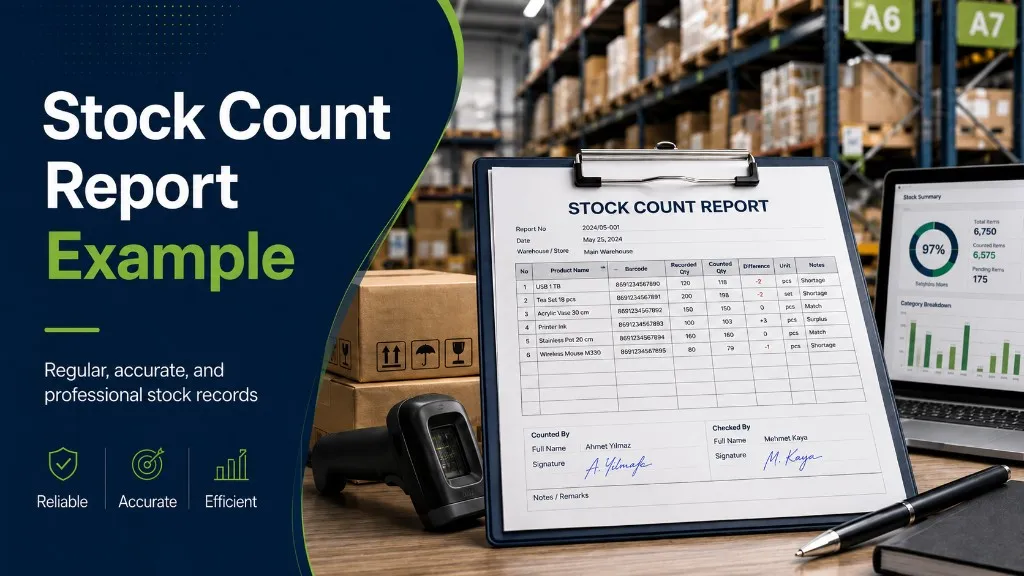
Stock Count Report Example: Mandatory Fields, Key Considerations, and a Ready-Made Guide
Year-end inventory is approaching or you need to prepare a report before a periodic audit — but you're not exactly sure what goes where. An incomplete or incorrectly prepared report can open the door to serious problems in both accounting processes and potential audits.
A stock count report is an official document prepared to definitively determine a business's existing inventory at a specific date by physically counting, measuring, weighing, and valuing it. In this guide, you'll find the mandatory fields, preparation process, and frequently made critical mistakes needed to create a valid stock count report example.
What Is a Stock Count Report and Why Is It Required?
This document is not just a form; it's a legal record that documents a business's inventory reality. Tax legislation makes this obligation mandatory both at the opening of a business and at the end of each accounting period. The stock counting process is therefore not a random calendar-based practice but a legally grounded systematic process.
So what does a flawed report mean? Incorrect stock data directly leads to order surpluses or production shortfalls. Financial statements are fed by this data; financial reporting becomes inconsistent. The domino effect starts right here.
Mandatory Fields in a Stock Count Report
Knowing which fields must be included is critical for the report's official validity and usability. Addressing the fields in two main groups both speeds up the process and prevents overlooked items.
Header and Identification Information
This group documents who the report belongs to and under what conditions it was prepared. In practice, this is also the most frequently skipped section — especially in multi-location businesses, the branch information is often left blank. When party information is incomplete, the report loses its evidentiary power in audit or dispute processes.
| Field | Description | |---|---| | Company Name | Full trade name of the business conducting the count | | Count Date and Time | The day and time the physical count took place | | Warehouse / Location Name | The warehouse or branch where the count was conducted | | Page Number | For sequence tracking in multi-page reports | | Warehouse Manager's Name and Position | Mandatory for the report's evidentiary value | | Workplace / Branch Information | Provides differentiation when multiple locations exist |
Never leave these fields blank — especially in multi-location businesses, branch information remains the most frequently skipped field.
Count Detail Fields
This group forms the core content of a warehouse stock count report. Each row represents a product. Every field entered incorrectly or left incomplete can turn into a potential stock discrepancy or accounting error.
- Product Barcode: Mandatory for matching with system records; an incorrect code disrupts stock tracking.
- Product Name / Category: Prevents confusion between similar products.
- Unit (pieces / kg / liters etc.): An incorrect unit directly affects the total amount.
- Counted Quantity: The raw data of the physical count.
- Unit Price and Total Amount: Critical for stock valuation; these figures are reflected in accounting records.
- Stock Movements (purchase / sale / return): Clarifies the net stock position at the time of counting.
- Storage Location: The product's position in the warehouse; saves time in future inspections.
How to Prepare a Stock Count Report? Step-by-Step Process
Managing the counting process correctly is just as important as filling in the report properly. Addressing the process in three stages both increases stock control quality and reinforces the report's reliability.
Pre-Count Preparation
Most counting errors are actually made before the count begins. If accounting records aren't up to date, inevitable confusion arises in the field — that's why records must be checked before the count date. All departments should be informed, a counting team consisting of trained personnel should be assigned, and count lists should be prepared in advance. This preparation prevents time loss in the field while also minimizing overlooked items.
What to Watch for During the Count
Once counting begins, purchase and sales transactions must be stopped. Otherwise, constantly changing figures render the report meaningless. The dual verification principle is vital here: a count based on a single person's observation multiplies the risk of error. Using barcode scanners both speeds up the process and increases accuracy. Areas that are out of sight — such as storage rooms, under-stairway spaces, or unused corners — must not be skipped; transit and returned products should be noted separately. A constant truth in practice: the largest stock discrepancies most often come from these "invisible" areas. Especially in retail businesses, the count should be completed uninterrupted from the last closing hour to the next opening.
Post-Count: Completing the Report and Signature Process
The real work begins after the physical count is done. Counted quantities are compared with system records; identified stock discrepancies are clearly entered into the report. To increase the report's evidentiary value, signatures from the warehouse manager and authorized executive should be obtained. Inventory corrections should be reflected in accounting records; shortages, damages, or losses should be separately noted in the document. This stage is also an opportunity to review stock processes from scratch. If you want to systematize your warehouse counting, our how to perform warehouse inventory counting guide explains the process step by step.
Common Mistakes in Stock Count Reports and How to Avoid Them
Businesses encounter similar problems at this point. Four critical error categories stand out.
1. Not following the dual verification principle
The warehouse manager counted alone, signed the report — but who will verify? An inventory count based on a single person's observation lacks a mechanism to detect errors or intentional discrepancies. Creating a team of at least two people for each counting zone eliminates this risk.
2. Skipping areas that are out of sight
Storage room, under the stairs, unused warehouse corner? When these areas aren't counted, stock discrepancies become inevitable. Before the count, prepare a counting list that covers all warehouse areas and proceed by checking off each zone one by one.
3. Ignoring transit and returned products
Products for which a return waybill has been issued but physical removal hasn't been completed; stocks that have been dispatched but haven't reached the buyer — all of these create uncertainty in the report. From what we've observed in the industry, this item continues to be the most frequently encountered source of problems in variance analyses. Noting these products on a separate line at the time of counting prevents inconsistencies that may arise later.
4. Not updating stock data after the count
The count is complete, the report is signed — but system records haven't been updated. In this case, all effort goes to waste. Stock tracking remains inconsistent, and financial reporting produces erroneous data. After the count report is approved, process inventory corrections into the accounting system on the same day.
Conclusion
A report is not just numbers on paper — behind it lies a business's inventory reality. Ultimately, a report is not a formality; it's a tool that documents uncertainties in stock processes and provides assurance in audits. In this guide, we covered mandatory fields, the three stages of the counting process, and the four most frequently made critical mistakes. In your next stock counting process, you can use this information as a reference to create a complete and valid stock count report example.
Contact us to download our ready-made stock count report template or to learn more about our stock counting services.