Stock Counting Companies: A Complete Guide to Choosing the Right Service and Technology
What Is Stock Counting and Why Does It Need Professional Support?
A pen, a notebook, and endless rows of shelves; a "closed" sign on the door until the count is finished. For most businesses, the story of manual counting is exactly this familiar. Hours of effort, mounting fatigue, and in the end the number on paper never quite matching the product on the shelf. The real issue isn't limited to lost time, either; the numbers show how serious it is. While average inventory accuracy in businesses sits around 83%, in physical retail stores it can drop to 65%. Yet the ideal level that prevents operational chaos is 97% and above. That gap alone explains why the right stock counting approach is not a preference but a necessity.
Here's the essence: accurate stock counting is the combination of the right firm, the right software, and the right hardware. When you search for "stock counting companies," you actually need to weigh these three pillars together. In this guide we'll cover firm-selection criteria, the features a counting tool must have, and the difference between a handheld terminal and scanning barcodes with a camera one by one. That way you can confidently make the right decision for your own sector.
So what exactly is stock counting? It isn't just about finding quantities; stock counting is not merely a "let's count the products" process but also a process of control, audit, analysis, and prevention. The real work is seeing where loss occurs, which product is quietly disappearing, and which shelf needs attention. In the manual method, typos, overlooked products, and the need to halt operations slowly turn into stock loss. Professional stock counting, on the other hand, turns this into a systematic inventory management discipline; it both raises accuracy and lets you keep working without suspending your business for days.
Who Does Stock Counting? How Service Providers Operate
Once you see the value of professional support, the first question that comes to mind is: who will take on this job? Stock counting can be carried out with a team assigned from within the business. However, businesses that want to reduce the margin of error and avoid disrupting operations often outsource this work to professional firms. Among stock counting companies, alongside those serving general retail, there are also firms specialized in a particular sector, such as pharmacies or auto spare parts. This specialization is not pointless; the shelf layout of a pharmacy and the needs of an auto spare parts warehouse are diametrically opposed.
So how does stock counting proceed in the field? A professional stock counting service generally runs in four stages: first the business is visited and product volume and shelf layout are planned; then a trained team goes on site and scans every product one by one using the barcode-based stock counting method; the collected data is transferred to the existing software; and finally a variance report is produced. The real value that most competitors gloss over with a "years of experience" claim is hidden in this very last step. A good stock counting firm doesn't hand you a dry list of numbers; it provides an analysis showing how much variance occurred on which product, where loss is concentrated, and which aisle you need to watch. A stock count report example that documents the result is also drawn up at this stage.
When and How Should Stock Counting Be Done?
In the classic approach, counting is done once a year, at year-end. Yet for an average retail store to perform a full physical count only once a year causes errors to silently accumulate over 12 months. The alternative is cycle counting. In this method, operations never stop; a specific section of the warehouse is counted every day, eliminating the stress and workload created by a year-end count. Especially in large-area businesses, the answer to how to count warehouse inventory lies in this very system. For businesses with high circulation, the right timing is not "once a year" but at regular intervals, section by section.
Features a Stock Counting Software Must Have
How efficiently the field process runs is largely determined by the software behind it. Because what matters as much as the hardware is the software that drives it. When choosing a stock counting software, the question "does it read barcodes?" is not enough. The following features determine the difference between a count finishing error-free and weeks of corrections. We recommend carrying these items like a checklist when you go to meet a firm.
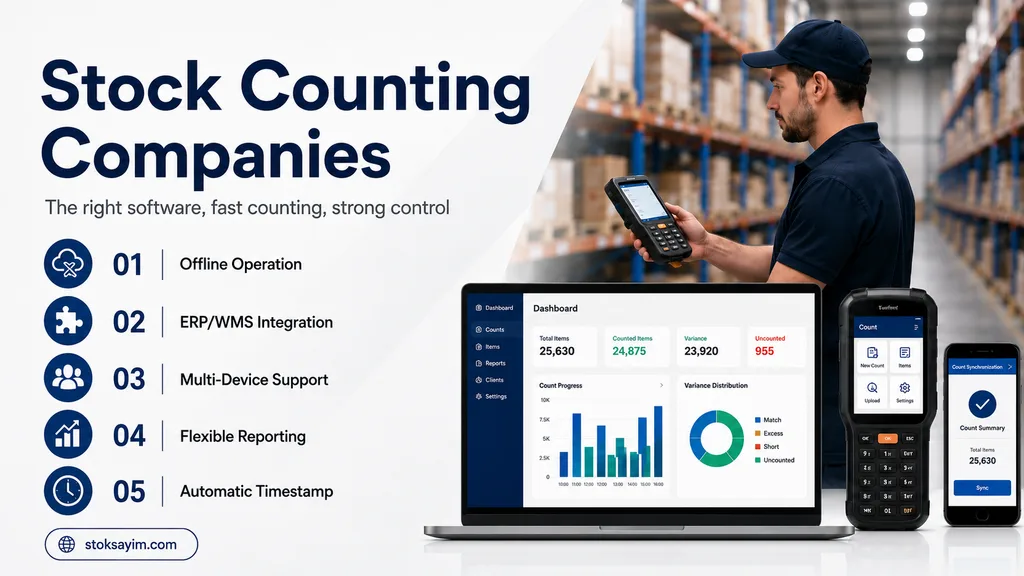
- Offline operation: Modern stock counting software, thanks to offline counting, prevents operations from stopping even if the internet goes down; the collected data is transferred automatically when the connection returns. In the no-signal corners of a warehouse, this feature is a lifesaver.
- Android integration: The software's compatibility with Android barcode reader handheld terminals and smartphone cameras minimizes errors caused by manual data entry. This way you can count with the devices you already have, without investing in extra hardware.
- Compatibility with your existing stock tracking software: Smoothly transferring count results into the stock tracking software or accounting system you use eliminates double data entry.
- Real-time reporting: Seeing variance reports instantly as the count progresses lets you catch a problem the moment it happens, not at the end of the count.
- Duplicate and missing product alerts: Good software instantly reports when the same barcode is scanned twice or when a shelf hasn't been counted at all.
When choosing a firm, be sure to ask whether the software has these features. Them saying "we have it" isn't enough; ask for a demo.
Stock Counting Hardware: Handheld Terminals, Android Devices, and Camera Barcode Scanning
After choosing the right software, it's time for the hardware that will carry that software into the field. Three core solutions stand out here: professional handheld terminals, Android devices, and barcode scanning with a smartphone camera. The difference confuses most businesses. Yet the choice becomes clear on its own once you look at the size of your warehouse and the intensity of your counting.
A handheld terminal is a durable device that, with a physical trigger and a laser/imager module, reads hundreds of barcodes within seconds. With phone-camera stock counting, no extra hardware is involved; your existing phone's camera serves as a barcode reader. Thanks to the Android compatibility we just mentioned, both kinds of hardware talk to the software seamlessly. So the critical difference comes down to speed, durability, and cost; which one suits you is decided by your use case.
What to Consider When Choosing a Handheld Terminal
When choosing a stock counting handheld terminal, looking only at the barcode-reading feature is not enough. Reading distance, screen size, battery life, drop resistance, and compatibility with your existing stock tracking software must be evaluated together. In busy warehouse and store environments, the device passes from hand to hand all day, gets dropped, and contacts dust. That's why industrial ruggedness and long battery life go to the top of the list. A long-range barcode reader that can read labels on high shelves from a distance also significantly shortens counting time.
Stock Counting by Scanning Barcodes with a Phone Camera
Is there a way to start counting when you don't have extra budget? There is. Camera barcode scanning is a practical alternative for small businesses that want to get started without investing in extra hardware. Auto spare parts shops or small grocery stores can switch to digital counting without allocating a budget, using an app installed on an Android phone they already own. Of course it isn't without drawbacks: a camera reads more slowly than a professional handheld terminal, struggles in low light and with worn labels, and hits battery and speed limits in high-volume warehouses. That's why camera barcode scanning is tailor-made for low- and medium-volume inventories, while in large operations it is positioned as a supporting solution.
The Right Stock Counting Solution for Your Sector: Grocery, Retail, and Auto Spare Parts
The right choice of hardware and software gains meaning when combined with the unique needs of your sector. Because every business has a different inventory structure, and there's no such thing as "one solution that fits everyone." Stock counting companies serving grocery stores usually focus on fast shelf counting and high turnover. In a market where hundreds of different products are constantly replenished throughout the day, what matters is building a flow that can count the registers and shelves within minutes without disrupting operations; the answer to how grocery store stock counting works lies here, in rapid barcode scanning and planning aligned with cashier shifts.
Auto spare parts stock counting, on the other hand, wrestles with a completely different challenge: high SKU variety. Thousands of nearly identical parts, different brand equivalents, and products lined up in small boxes make counting by eye almost impossible. In this sector, a barcode-based system that can match accurately significantly lowers the margin of error. The answer to how retail store inventory counting is done also varies by product range; in textiles, size-color variations stand out, while in electronics, serial number tracking does.
In large-area businesses, warehouse counting is a discipline of its own; without shelf addressing and zone-by-zone planning, large stocks can't be managed. Ultimately, the right solution comes from choosing software and hardware together, according to the volume and product variety of your sector.
The Cost of Outsourcing Stock Counting and Criteria for Choosing the Right Firm
Once the right match of hardware and software is clear, what remains is the budget side. The cost of outsourcing stock counting can't be reduced to a single figure; the number of products, the number of locations, and the level of technology used are the main items that determine the price. A warehouse holding thousands of SKUs and a small single-shelf shop are naturally priced differently; in multi-branch businesses, logistics and team planning are added to the cost. That's why, when researching stock counting firm prices, it's much healthier to question which items a quote covers rather than expecting a clear-cut list.
Manual counting has no visible bill. But its hidden cost is quite high. Typos, lost products, and low inventory accuracy eventually far exceed the price of a professional service. The value of choosing a professional stock counting service comes from exactly here: preventing an error upfront always comes cheaper than fixing it later.
When choosing a firm, ask these questions like a checklist: Is the count done with software that can work offline? Is it compatible with your existing stock tracking program? Is a post-count variance report and analysis provided? Which hardware (handheld terminal, Android device, camera barcode) is used? Stock counting companies that answer these clearly don't just count; they build a reliable data infrastructure for your business. This wholeness, where the right firm, the right software, and the right hardware come together, is the real factor that lifts inventory accuracy to the ideal 97%-and-above level.
Frequently Asked Questions
What exactly do stock counting companies do?
Stock counting companies use a trained team and barcode-based counting software to count your business's physical stock one by one, compare it with system records, and finally provide a variance report and analysis. The goal isn't just finding quantities; it's raising inventory accuracy by pinpointing where loss occurs.
How much does it cost to outsource stock counting?
The cost can't be reduced to a single number; the number of products (SKUs), the number of locations, and the level of technology used determine the price. A single-shelf shop and a warehouse with thousands of SKUs are naturally priced differently. So when getting a quote, it's better to ask which items the price covers than to expect a flat list.
Which is better, a handheld terminal or camera barcode scanning?
For high-volume, multi-staff operations, a durable and fast handheld terminal is more efficient. For small and medium-sized businesses, scanning barcodes with a smartphone camera is a sufficient solution without extra hardware cost. The choice is determined by the size of your warehouse and the intensity of counting.
What is cycle counting?
Cycle counting means regularly counting a specific section of the warehouse every day instead of doing one full count a year. Operations continue without stopping, errors are caught early before accumulating over 12 months, and the stress created by a year-end count disappears.
Should I count with my own team or with a professional firm?
Counting can be done with an in-house team; however, for businesses that want to reduce the margin of error and avoid disrupting operations, a professional firm working with the right software delivers more reliable results. What's critical is that the software works offline, is compatible with your existing stock tracking program, and provides post-count analysis.
When researching stock counting companies, you now know which features to question; that's the first step to making the safest choice for your business. To try Stock Sayım Analiz software on your own count, request a demo; let's evaluate the right firm, the right software, and the right hardware under one roof.